
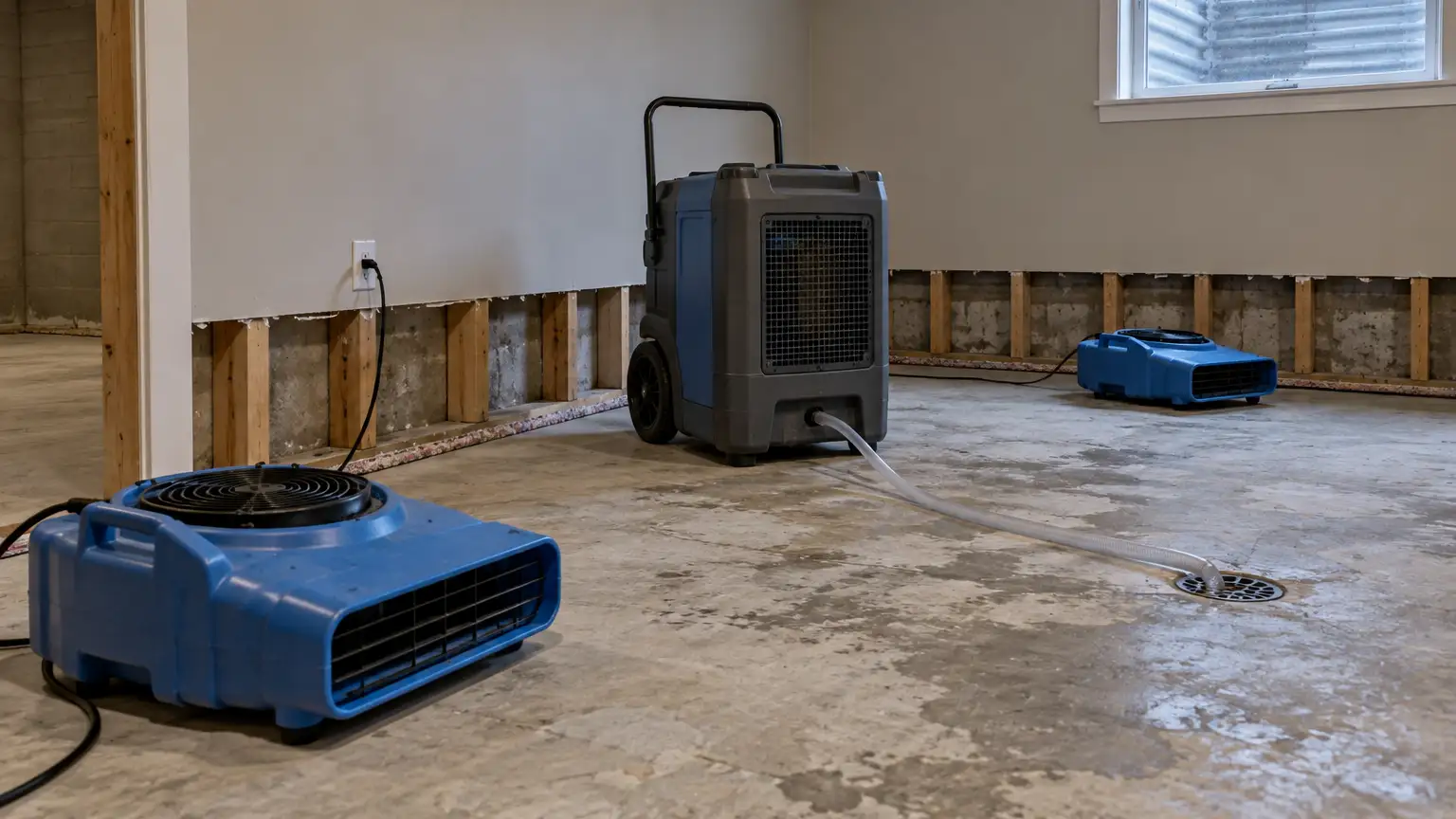
Emergency water removal comes before anything else
While standing water is present, every other step is slower and the affected area keeps growing. Bulk removal therefore comes first, with extraction equipment that draws water out of carpet and padding under vacuum rather than lifting it off the surface. On hard flooring the question is what has already traveled beneath it, through seams in plank and laminate and into the subfloor or the slab.
How much is extracted mechanically sets how long the drying phase runs. Every gallon pulled out with a machine is a gallon that does not have to be evaporated into the air and then condensed back out of it, which is a far slower way to move the same water.
Water extraction and drying in Kenosha County basements
A building holds water in its materials, not only on its surfaces. Drywall, framing, subfloor, insulation, plaster and concrete all absorb it and give it back slowly. Structural drying is the controlled process of returning those materials to the moisture level that is normal for that building, and below grade it has to fight a space with almost no natural air exchange.
Air movers are placed to break the thin layer of saturated, still air that forms against a wet surface. Until that layer is disturbed, evaporation nearly stops, which is why a wet basement floor in a closed room stays wet for days. Dehumidifiers then take the released moisture out of the air. Without them, humidity climbs and the moisture redeposits into materials that were dry, which is how a loss in one corner ends up affecting the whole lower level.
Where water has entered a wall cavity, drying the visible surface is not enough. Cavities are dried through directed airflow at the base of the wall, through small inspection openings, or by removing a band of drywall or paneling where the assembly cannot be reached any other way.
Measurement rather than guesswork
Meters are used on the affected material and on the same material elsewhere in the house where it stayed dry. That second reading is the baseline for that particular structure, and it matters here because two very different kinds of building sit side by side across these counties. A pre-1940 house in Racine or old-town Kenosha has plaster over wood lath, plank subfloor and a stone or early block foundation, all of which hold water and release it slowly. A house from the 1990s in Pleasant Prairie or Mount Pleasant has drywall on studs over a poured wall, which dries quickly once the floor covering is up but hides water behind rigid foam board. The same amount of water gives two different schedules.
Readings are logged on each visit. Equipment stays until the affected readings return to baseline. For a contained loss caught early that is commonly three to five days; plaster, hardwood, block and concrete hold water considerably longer and can take a week or more.
What gets dried and what gets removed
Clean water caught quickly lets most of the structure be dried in place. Carpet padding usually comes out regardless, because it holds a great deal of water and dries slowly enough to keep the carpet above it wet. Where water was contaminated, or material has been saturated long enough that its integrity is affected, removal replaces drying. Saturated insulation is the common example below grade: it loses its function and holds water against the framing and the rim joist.
Water extraction and drying in Kenosha County, city by city
- Water Extraction in KenoshaZIP 53140, 53142, 53143, 53144
- Water Extraction in RacineZIP 53402, 53403, 53404, 53405, 53406
- Water Extraction in Mount PleasantZIP 53403, 53405, 53406
- Water Extraction in Pleasant PrairieZIP 53158, 53142
- Water Extraction in Salem LakesZIP 53168, 53170, 53179, 53192
- Water Extraction in Paddock LakeZIP 53168
- Water Extraction in BristolZIP 53104
- Water Extraction in SturtevantZIP 53177
- Water Extraction in Twin LakesZIP 53181
- Water Extraction in SomersZIP 53171, 53144
- Water Extraction in BurlingtonZIP 53105
Water extraction and drying in Kenosha WI: common questions
- How is extraction different from mopping or shop-vacuuming?
- Extraction units pull water out of carpet and padding under vacuum rather than lifting it off the surface. Most of the water in a carpeted room is held in the padding underneath, and surface methods leave it there. A shop vacuum also has no way to reach water that has already moved under the tack strip into the base of the wall, which below grade is where most of it goes.
- Why do dehumidifiers matter if air movers are already running?
- Air movers move moisture out of materials and into the air. If nothing takes it out of the air, humidity in the room climbs and that moisture settles back into materials that were dry, including furniture and adjacent rooms. Dehumidification is what actually removes water from the building. In a closed basement with little natural air exchange, this is the half that does the work.
- How is it decided what gets dried and what gets removed?
- It comes down to the type of water, how long the material was wet, and whether it can return to normal moisture without deforming. Clean water caught early allows most structural material to be dried in place. Carpet padding is usually removed regardless because it holds water and dries slowly. Contaminated water shifts the balance heavily toward removal.
- How is drying confirmed rather than assumed?
- Meters are used on the affected material and on the same material elsewhere in the building where it stayed dry, which establishes what normal means for that structure. Readings are logged each day. Equipment stays until the affected readings match that baseline, which is why the schedule follows the readings rather than a fixed number of days.
- Can equipment be pulled early to save money?
- It can be, but it moves the problem rather than solving it. Material left above normal moisture keeps water inside the assembly, and that is the condition where growth begins. Ending drying early is the most common reason a loss that appeared resolved comes back as a musty smell and a stained wall a few weeks later.